
Overheating Inductor in Satellite High Power System Rapidly Solved with MADMIX
Despite rigorous simulations, the real-life operating behavior of an inductor within the application can vary from expectations. At a late development stage, discovering unexpected component behavior can be a critical situation. The project impact with redesign and re-qualification steps have very significant cost and timeline impacts. In the space industry, project delivery deadlines are particularly tight with high stakes.
Such an unexpected inductor case nearly occurred with a close aerospace partner, Thales Alenia Space Belgium (TASB). A single magnetic component experiencing overheating threatened TASB’s delivery timeline on a batch of power units.
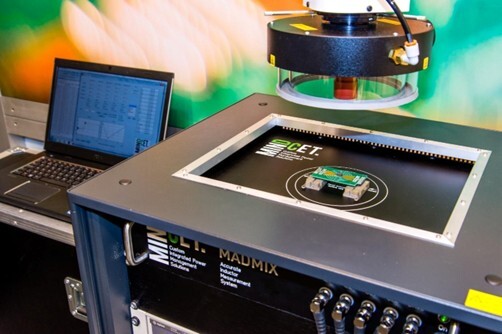
Over the years, MinDCet has developed several ASICs together with TASB and supports its advanced measurement and characterization capabilities. In this inductor instance, it was MinDCet’s MADMIX equipment that came into play.
MADMIX is MinDCet’s in-house developed and patented inductor measurement system. The MADMIX characterizes the power losses of magnetic components (including AC losses) under hard-switching conditions as seen in application. In the recent collaboration, MinDCet and TASB used MADMIX to measure power dissipation in the problematic magnetic component as well as test alternative parts to replace it in the design. Within only a few hours, the core losses of the various inductor components were characterized across several operating points. The key advantage for TASB was the closely matching measurement conditions (high voltage) to the final application, all captured in a short time span. The measurement data acted as the basis to conclude on a fitting solution with a high confidence level.
In this particular situation for TASB, the MADMIX measurements helped avoid a major impact at an advanced development stage. Additionally, it highlighted a new approach of integrating MADMIX inductor measurements early in the magnetics selection and design stage. The measurement data ensures an informed, real-application data driven decision and reduces risks as early as possible.