

MRI-Compatible Low-Power ASIC for a hearing aid implant
Current medical practice still largely excludes patients with implanted medical devices from undergoing magnetic resonance imaging (MRI) scanning. Even in the case of state-of-the-art implants, only patients with a single implant may be scanned and, even then, under severe restrictions. The DISPERSE project addresses these limitations by enabling new levels of MRI compatibility, while also creating benefits that extend into other high-reliability technology domains.
For the DISPERSE project, MinDCet has developed a dedicated methodology for designing MRI compatible ASICs. As a representative use case, we designed an ASIC for a low-power biomedical hearing aid implant, which was successfully tested in both 1.5T and 3T MRI scanner environments. This demonstrated the feasibility of developing active implantable medical device (AIMD) electronics that significantly reduce interference with MRI imaging, while also relaxing constraints on allowable MRI field strengths.
As an outcome of DISPERSE, MinDCet has established a structured methodology for designing what we define as “mag-hard” ASICs. Mag-hard we understand as compatible, or tolerant, to high magnetic and RF fields. This capability is not only relevant for biomedical implants, where low power consumption is essential, but also for applications in other harsh environments where conventional IC designs are not sufficiently robust.
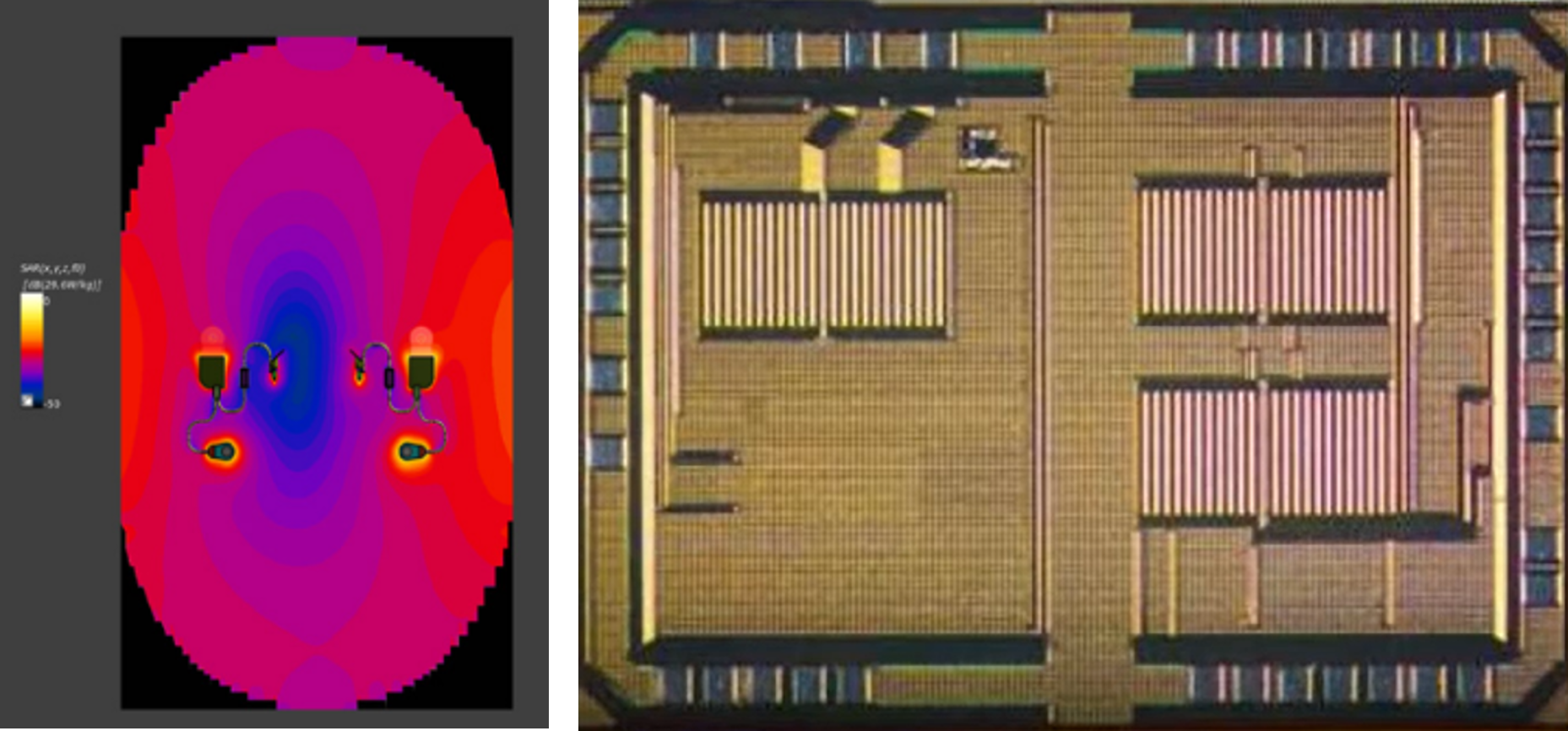
Left image: SAR field for 2 middle-ear implants at landmark 0 cm. Inter- implant distance of 9 cm. Right image: Microscope image of the ASIC